Key Takeaways
- A vCIO provides technology leadership and planning, not hands-on support. The two are frequently sold together and are different jobs.
- The value is in the decisions: what to invest in, what to retire, what risk to accept, and in what order.
- If your provider’s vCIO only ever recommends more of that provider’s services, you have a salesperson with a title.
- A business may need one when technology spend starts outrunning technology understanding.
What a vCIO actually does
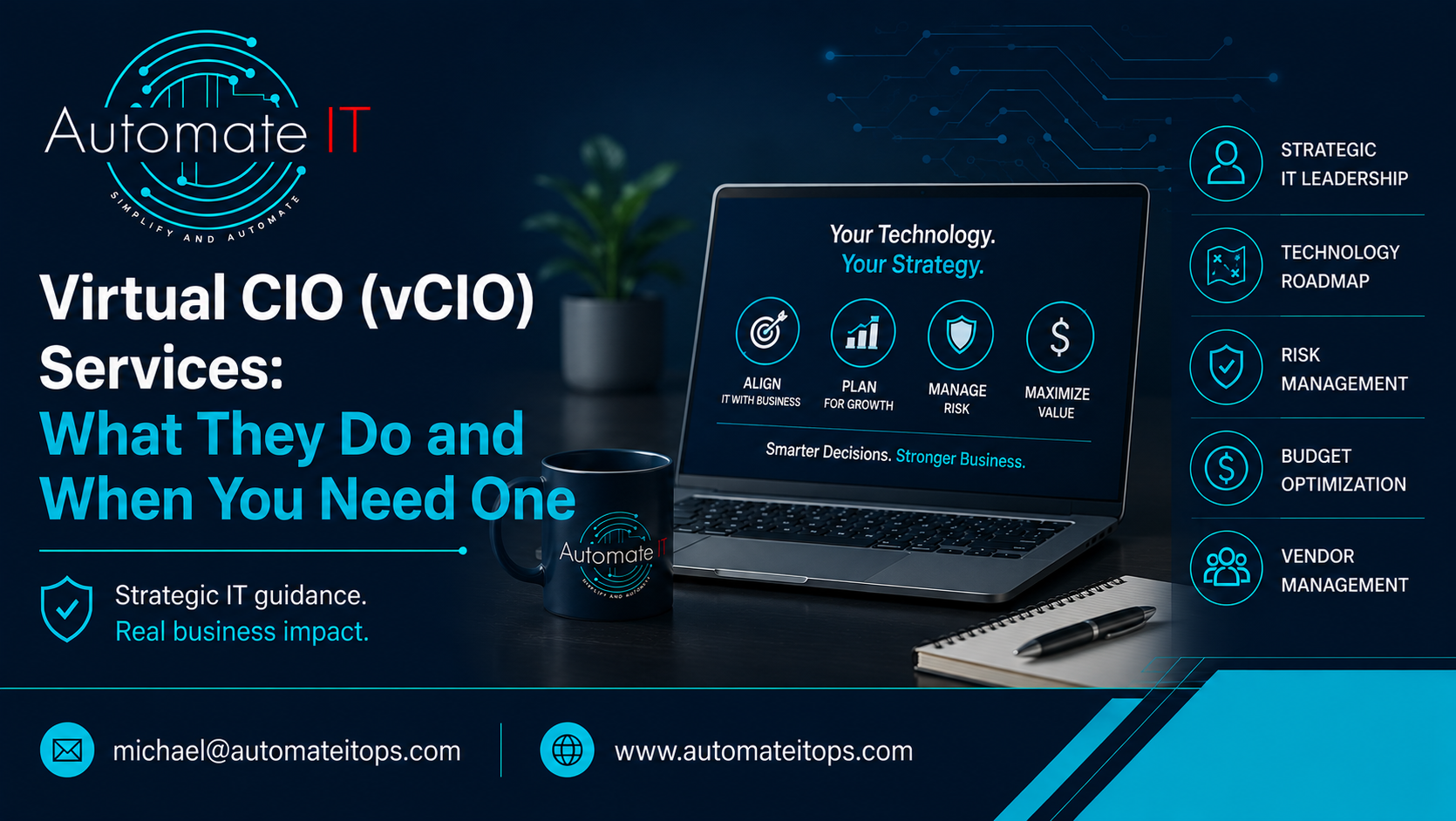
Virtual CIO services provide selected technology leadership functions typically associated with a full-time chief information officer, on a fractional basis. That is planning, budgeting, risk assessment, vendor strategy and roadmap ownership. It is deliberately not the help desk, and a provider blurring the two is worth questioning.
If you are asking what is a vCIO, the simplest answer is a technology leadership function focused on decisions, planning and accountability rather than day-to-day technical support.
- Technology roadmap tied to business objectives rather than to product cycles
- Budget planning and capital forecasting, including refresh cycles
- Risk assessment and the decision of which risks to accept
- Vendor and contract strategy
- Security posture governance, distinct from security operations
- Board and executive reporting in business language
How it differs from managed IT support
Understanding the difference between vCIO leadership and managed IT support is important because the two roles solve different problems.
| Managed IT support | vCIO | |
|---|---|---|
| Question answered | Is it working? | Is it the right thing? |
| Time horizon | Now and this month | This year and next |
| Output | Resolved incidents, monthly reporting | Roadmap, budget, risk register |
| Who they talk to | Users and IT staff | Executives and the board |
| Measured by | Uptime and resolution | Decisions and outcomes |
For organizations with an internal IT capability, Co-Managed IT Services can also be an option where the internal team retains some responsibilities while an external provider supplies additional capacity or expertise.
When a business genuinely needs one
A fractional CIO can be useful when a business needs senior technology leadership without hiring a full-time CIO.
- Technology spend has grown faster than anyone’s understanding of it.
- You are making significant infrastructure decisions with no internal person qualified to challenge the vendor.
- A regulator, insurer or major customer has started asking governance questions you cannot answer.
- You have managed IT support and still have no plan, only a stream of resolved tickets.
- An acquisition, expansion or system replacement is coming and nobody owns the plan.
- NIST added the Govern Function in CSF 2.0 to emphasize the critical role of cybersecurity governance in managing and reducing risk. A vCIO can help a mid-market organization establish and maintain some of these governance practices.
What a good engagement looks like
Good vCIO services should produce a documented roadmap, risk register, budget forecast and executive reporting.
- A documented technology roadmap, reviewed quarterly rather than written once
- A risk register with owners and decisions, not just a list of concerns
- Budget forecasting that includes refresh cycles rather than only running costs
- Executive reporting a non-technical board can act on
- Independent recommendations, including recommending things the provider does not sell
A vCIO engagement should be defined around the decisions and outcomes the organization needs rather than simply adding another layer of meetings.
The conflict of interest worth naming
There is a structural tension in most vCIO arrangements: the person advising you on what to buy frequently works for the company selling it. That does not make the advice wrong, and pretending the tension is absent is worse than acknowledging it.
Two practical tests. Ask when the vCIO last recommended something the provider does not sell. And ask whether the roadmap includes anything that reduces what you spend with them. Good answers exist. Absent answers are informative.
Client Case Card
Client environment: A large hospital. Outcome: Problem management time reduced by 80%, with 100% availability through proactive and predictive alerts.
This is evidence of operational method rather than a directly comparable advisory engagement.
Frequently Asked Questions
What is the difference between a vCIO and a vCISO?
A vCIO owns technology strategy broadly: roadmap, budget, vendors and risk. A vCISO focuses specifically on security governance and posture. An organization may have both roles, while smaller and mid-market organizations may combine some of these responsibilities.
Is a vCIO the same as an IT consultant?
Consulting is usually engagement-based and finishes. A vCIO is an ongoing role with continuing accountability for the roadmap. The difference is continuity.
How often would we meet?
Quarterly can be a practical rhythm for roadmap and budget review, with additional involvement around specific decisions. More frequent involvement may be appropriate in regulated sectors or during a major programme.
Can our managed IT provider also be our vCIO?
Commonly yes, and it is worth being clear-eyed about the conflict. The provider knows your environment better than anyone, which is genuine value. Ask the two questions in the section above.