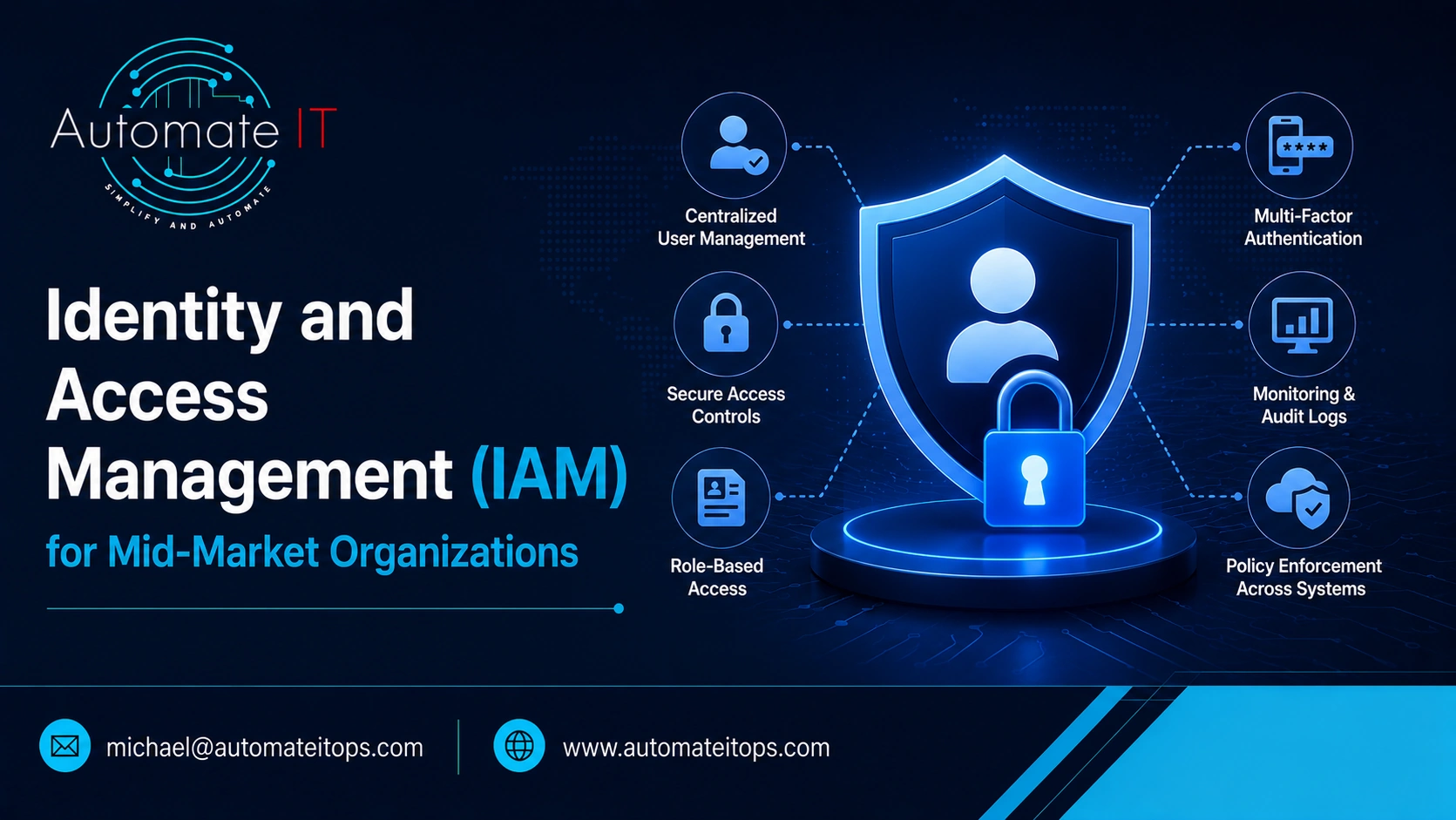
Identity and Access Management (IAM) for Mid-Market Organizations
AutomateIT Infrastructure TeamSenior Cloud Operations • Published September 1, 2026
Key Takeaways
IAM is about who can reach what, and being able to prove it on request.
The common failure is not onboarding. It is movers and leavers, where access accumulates and never gets removed.
Multi-factor authentication is a high-value first step and is increasingly expected by cyber insurers.
Access review is a control auditors commonly ask for, yet many organizations struggle to evidence it.
What does IAM actually cover?
Identity and access management, usually shortened to IAM, is the set of processes and controls determining who can access which systems, under what conditions, and how that access is evidenced.
For mid-market organizations, IAM typically covers multi-factor authentication, single sign-on, joiner-mover-leaver processes, privileged access control and periodic access review.
The most common weakness is not initial account creation. It is that access accumulates as people change roles and is rarely fully removed when they leave.
IAM is therefore an ongoing process rather than simply a product purchase.
Component
The risk it addresses
Multi-factor authentication
Stolen passwords and compromised credentials
Single sign-on
Password reuse and shadow accounts across applications
Joiner, mover, leaver
Access that accumulates and is never removed
Privileged access
Administrative accounts with standing, unmonitored power
Access review
Being unable to evidence who has access to what
Role definitions
Permissions granted person by person with no consistent pattern
The product supports these processes; it does not replace them.
The NIST Digital Identity Guidelines, SP 800-63, set out technical requirements for identity proofing and authentication, with the current 800-63-4 revision superseding the earlier authentication volume.
Why do movers and leavers cause more damage than joiners?
Onboarding is visible. Someone starts, they cannot work, and the access gap gets fixed quickly.
Offboarding is different. Nothing breaks when access is removed incorrectly or, more importantly, when it is not removed at all.
Consider what happens when an employee changes roles:
Someone moves from finance to operations and gains operations access.
Nobody removes the finance access because removing it could risk breaking something and there is no visible benefit.
The same pattern repeats over several years, and a handful of employees accumulate access across multiple systems.
When someone leaves, their primary account may be disabled while application accounts, shared logins and third-party tools are missed.
The organization then cannot confidently answer who has access to a particular system.
This is why access review exists as a control.
Reviewing access annually against a list nobody trusts is not an effective control. The review needs to produce evidence and result in changes where access is no longer appropriate.
What should a mid-market organization do first?
Not everything needs to happen at once.
IAM programmes can struggle when they begin with role redesign, because role design is one of the harder pieces to implement and may not provide the fastest immediate reduction in risk.
A practical sequence is:
Multi-factor authentication — Prioritize remote access, email, privileged accounts and other high-value access paths.
A documented leaver process — Include application accounts and third-party tools, not just the primary directory.
Privileged access inventory — Identify who has administrative rights and whether those rights are actually required.
Single sign-on — Use SSO for applications that support it to reduce credential sprawl and simplify revocation.
Access review — Establish a defined review cadence, beginning with the systems that matter most.
Role definitions — Design consistent roles once actual access patterns are understood rather than relying only on theoretical ones.
MFA can materially reduce the risk associated with compromised credentials and is a practical first priority. Partial deployment can leave important access paths unprotected.
CISA’s Cyber Essentials also places MFA among foundational cybersecurity practices.
How does IAM show up in an audit?
Auditors and examiners rarely care whether you have purchased a particular IAM product. They want you to demonstrate something specific.
Typical evidence questions include:
Who currently has access to this system?
When was this named leaver’s access removed?
Who approved this person’s elevated rights?
When was the last access review, and what changed as a result?
Are administrative actions logged and reviewed?
Each of these is an evidence question rather than simply a technology question.
An organization with modest tooling and reliable records can answer these questions more easily than one with sophisticated tooling and no defined process.
This applies across regulated sectors. Our Managed IT 360 offering covers the examiner-facing side, while identity evidence is a recurring theme in healthcare and financial services environments.
Can this be run without a security team?
Yes. Many mid-market organizations operate without a dedicated security team. The important point is that recurring IAM work still needs clear ownership and has to actually recur.
Useful capabilities include:
Automated joiner and leaver provisioning across connected applications
Continuous monitoring of privileged account usage
Scheduled access reviews with evidence produced as part of the process
Monthly reporting covering access changes and open exceptions
Automated provisioning can be particularly valuable. One environment supported by our team reduced user creation from 10 hours to under 10 minutes. The same automation removes access on departure and creates an audit trail.
That second half matters just as much as onboarding.
For a baseline, CISA’s cybersecurity best practices provide a useful public reference.
Client Case Card
Client environment: A global semiconductor manufacturer operating across the US and Asia, with 100,000 employees.
Problem: User provisioning took 10 hours per user and depended heavily on manual effort.
Solution: The provisioning and deprovisioning process was mapped and then automated across connected applications.
Result: Cycle time was reduced to under 10 minutes, with human error and person-dependency removed.
Evidence boundary: This demonstrates user lifecycle automation. It is not presented as evidence of a complete IAM programme deployment.
Frequently Asked Questions
Is IAM a product or a process?
Both, but the process is what determines whether it works. IAM products can enforce and provide evidence for access decisions, but they do not make those decisions for the organization. Without defined joiner, mover and leaver processes, purchasing IAM tooling can leave the underlying problems largely unchanged.
Is multi-factor authentication enough on its own?
No. MFA is a high-value control because it addresses the risk of stolen credentials. It does not address an existing employee retaining access they should have lost several role changes ago. That is where access review and lifecycle automation become important.
How often should access be reviewed?
Quarterly reviews for privileged and high-sensitivity systems and annual reviews for the wider estate can be a practical pattern. The more important issue is whether the review results in action. A review that never removes or changes access is not functioning effectively as a control.
What about shared accounts?
Remove shared accounts wherever possible because they weaken both accountability and offboarding. Where a system genuinely cannot support individual accounts, document the exception, restrict who has access to the credential, rotate it when someone leaves, and monitor its use.
Explore Related Insights & Guides
Handpicked IT operations, cybersecurity, and cloud architecture guides from our engineering team.
We use cookies to ensure that we give you the best experience on our website. If you continue to use this site we will assume that you are happy with it.